The Hidden Cost of Influencer Marketing (And What an Influencer Marketing Platform Actually Saves You)

Ask most people to describe influencer marketing and you'll get some version of the same answer: find a creator, get a post, watch the sales come in. Clean. Simple. Three steps.
The people who actually run programs know better. Behind that tidy picture sits a sprawl of research, vetting, negotiation, and coordination that never shows up on a budget line. Brands price the creator fee down to the dollar. Almost none of them price the work it takes to earn that fee's worth of results. And that's the problem. The real cost of running influencer campaigns, the cost that the right influencer marketing platform is built to remove, isn't hidden because it's small. It's hidden because it's spread across a dozen tasks nobody thinks to total up.
So let's total it up.
The six stages nobody budgets for
A real campaign is far more than one action. It's a chain of them, and every link takes time, judgment, and money.
1. Audience and trend research. Before you touch a creator, you need to understand what your target consumer actually watches, follows, and responds to right now. This shifts constantly, and getting it wrong poisons everything downstream.
2. Finding creators across platforms. Someone has to actually surface candidates on Instagram, TikTok, and YouTube. And most teams still do it by hand. A Modash survey of influencer marketers found that 73.2% rely on manually scrolling social media to track down relevant creators, while just 66.1% use dedicated influencer marketing software. In other words, the single most common discovery method in the industry is still thumb and screen.
3. Audience-overlap analysis. A creator's follower count tells you nothing about whether their audience overlaps with yours. Confirming that fit takes real analysis, and skipping it is how brands pay to reach the wrong people.
4. Brand-safety audits. Someone has to scan a creator's history for hate speech, harmful substances, and anything else that could turn a partnership into a liability. Done properly, this is slow. Done quickly, it's a gamble.
5. Outreach, negotiation, contracting, and onboarding. Every promising candidate has to be contacted, courted, priced, papered, and brought up to speed. Multiply that across a roster and it becomes a full-time job on its own.
6. Campaign management and tracking. Creative briefs, deliverables, feedback rounds, revisions, publishing, and then the reporting that tells you whether any of it worked. This is where campaigns quietly stall.
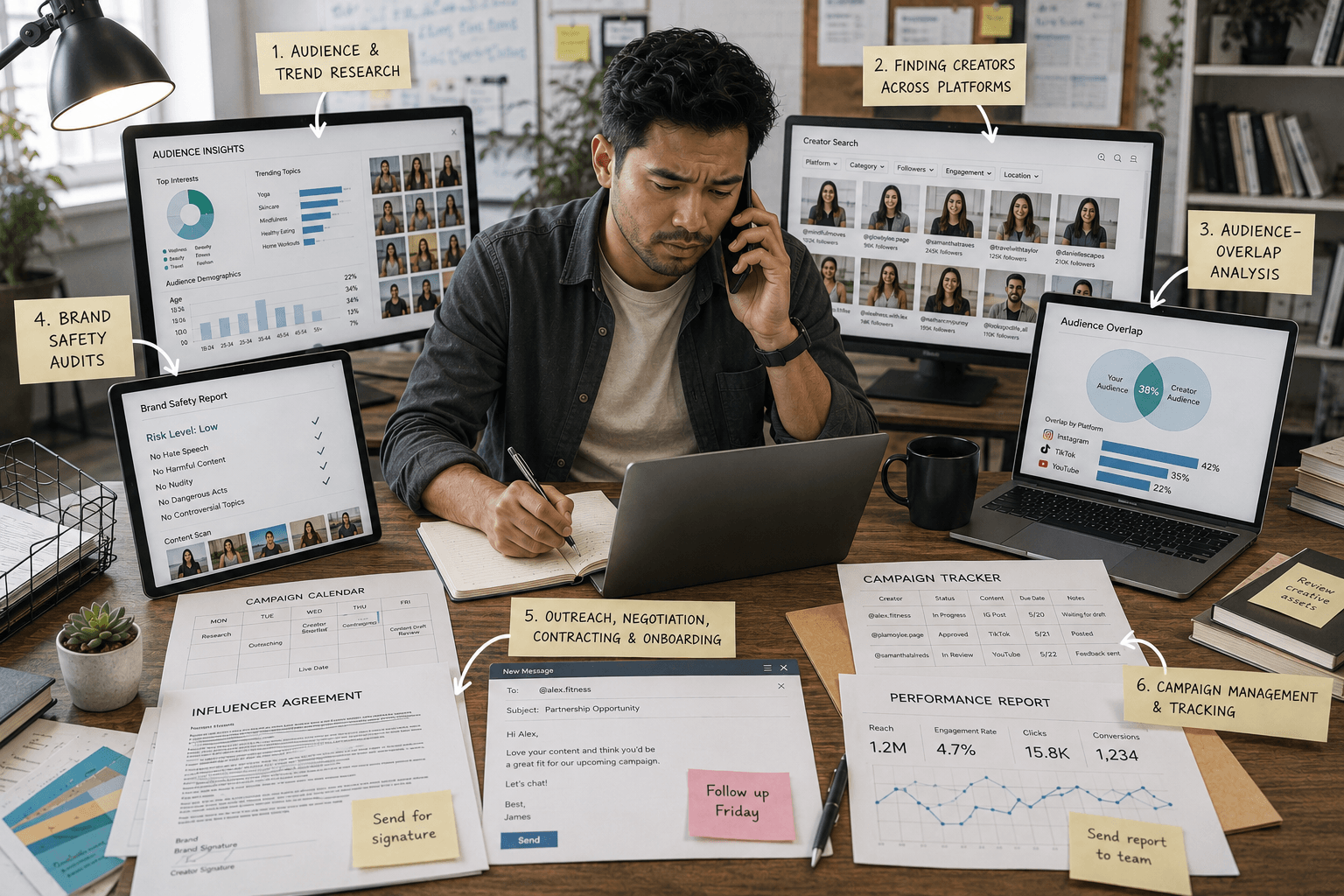
Six stages. Each one a cost center, yet the creator fee is often the number brands focus on most.
The real math: time, money, and ROI
Here's where it gets uncomfortable for anyone holding the budget.
If you run this in-house, you're paying for the person doing the work. A US influencer marketing manager earns roughly $83,000 to $116,000 a year, according to salary benchmarks from Salary.com, which works out to somewhere around $9,000 a month once you load in benefits and overhead, per Growth Assistant's cost analysis. That's before a single creator is paid.
Outsource it instead and the math doesn't get friendlier. Agencies typically charge a $3,000 to $25,000 monthly retainer, and then layer a 15% to 30% markup on top of every dollar you spend on creators. You're paying a premium on the fees themselves.
And the biggest expense isn't the one you'd guess. Research from Traackr found that the single largest cost in acquiring creator partnerships is employee time spent finding, vetting, and meeting with candidates, not the creator's fee.
Sit with that. The most expensive part of the process is the labor around the decision, not the decision itself.
Which leads to the point most cost conversations miss. Choosing the wrong creator wastes the time it took to get there, then puts campaign budget behind an audience unlikely to convert.
A bad pick charges you twice: once in salary, once in spend. That's an ROI leak, and it compounds every campaign you don't fix it.
The human-scale ceiling on ROI
If you're the one actually doing this work, none of the above is news. You already know vetting eats your week. The data just confirms you're not imagining it.
Marketers themselves name the problem plainly. In research from EMARKETER and Viral Nation, 38.5% say vetting is too time-consuming, 34.2% struggle to monitor creators continuously, and 28.2% point to a simple lack of automation. The work is manual, and everyone feels it.
So the corners get cut, quietly and understandably. Over half of marketers spend 30 minutes or less vetting a single influencer. Viral Nation estimates that a review that short covers roughly 0.01% of a creator's actual content history. You're making a partnership decision on a rounding error's worth of evidence.
And yet the confidence stays high. In the same research, 56.4% called influencer marketing "somewhat safe" and another 25.6% called it "very safe," a level of assurance a two-look-at-recent-posts review can't honestly support. That gap between how safe we feel and how much we've actually checked is where the trouble lives.
None of this is a people problem. It's arithmetic. No individual, and no team of any size, can exhaustively vet every creator at the scale modern programs demand. So a shortcut fills the gap by default: bias toward the names you already recognize, the creators who are already popular, the safe-feeling pick. Familiarity can feel like the responsible choice, even when it has little to do with actual fit. And it costs you ROI campaign after campaign, in creators you never found and audiences you never reached.
Why the fix isn't "just add AI"
The modern instinct is to hand the grind to a chatbot. Open ChatGPT or Claude, ask it to find creators in your niche, and let it do the digging.
It's a reasonable instinct that solves the wrong problem. Generic models can produce plausible answers without necessarily producing verified ones. They can name creators confidently without being grounded in live, checkable audience data, which means you get the feeling of research without the substance of it. Confident and wrong is worse than slow.
And even where a generic model helps, it only touches one stage: research. It doesn't run your outreach, hold your negotiations, onboard anyone, manage the briefs and revisions, or report on results. We've made this case at length in Why Generic AI Is Quietly Hurting Your Influencer Marketing ROI. The short version: a smarter search box doesn't fix a broken workflow.
What a purpose-built influencer marketing platform actually replaces
This is the distinction that matters. A purpose-built platform can speed up individual stages while connecting and automating the workflow from end to end.
Lickly is built around our proprietary M³VR™ (Multi-Model, Multi-Vector Reasoning Framework), which grounds recommendations in audience, creator, cultural and campaign intelligence. Map it against the six stages and the difference is obvious:
Audience and trend intelligence. Instead of manually piecing together what your consumer is watching, you get live signal on behavior and trends feeding directly into your decisions.
Cross-platform discovery and ranking. Rather than scrolling for hours, candidates are surfaced and ranked across platforms against your actual brief, not a hashtag guess.
Overlap and brand-safety audits at scale. Audience-fit analysis and content-safety checks that would take a person days run automatically across your whole list, so the shortcut of only vetting the familiar names disappears.
Outreach, negotiation, contracting, and onboarding. The coordination that quietly consumes a full-time role gets systematized, not scattered across inboxes and spreadsheets.
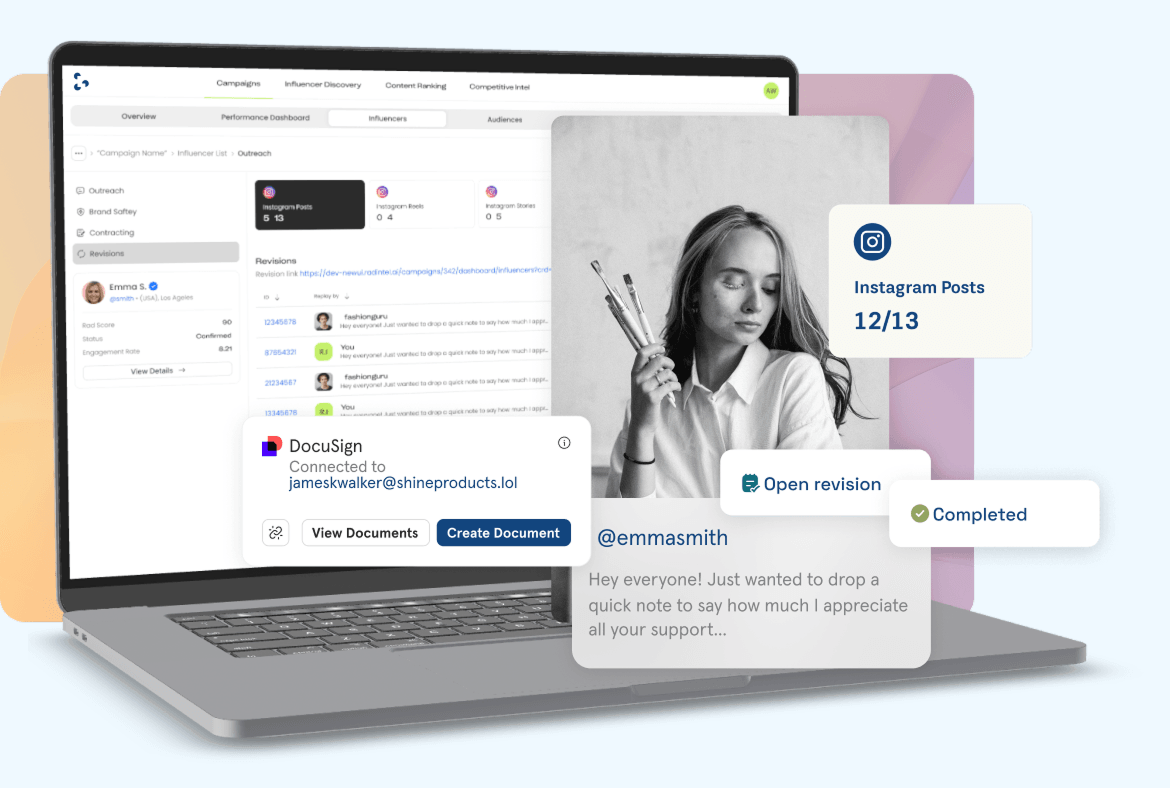
Creative brief to publish. Briefs, deliverables, feedback, revisions, and publishing live in one connected workflow instead of a dozen threads.
Post-level performance tracking. Granular, per-post reporting that tells you what actually drove results, so the next campaign starts smarter than the last.
Connecting those stages removes the fragmentation that creates so much of the extra work in the first place. A connected system can replace much of the fragmented stack around a manual program: the disconnected apps, spreadsheets, buried email chains, and handoffs where time and money leak out.
What this means for you
If you sign the budget. You reduce the manual workload, because the platform absorbs work that previously consumed significant staff time. You shorten time-to-market, because stages that ran in sequence now run together. You create the potential for stronger ROI, because decisions are grounded in audience data instead of familiarity alone. And you scale the program without scaling the team, which is the only version of growth that actually improves margins instead of eroding them.
If you do the work. You still own the research, the vetting, the outreach, and the reporting, but without the manual grind that buried them. The searching, cross-checking, and coordinating that ate your calendar gets handled, and what's left is the part that needed you all along: strategy, taste, and creative judgment. Less time proving a creator is safe. More time deciding what to actually make.
Book a demo
The real question was never "should we use AI?" It's this: is your program still paying a full staff's worth of time, money, and missed ROI for work a platform should be doing for you?
If the honest answer is yes, it's worth seeing the alternative. Not a faster search box bolted onto the same broken process, but the whole workflow running as one.
See what a campaign looks like when the entire workflow, not just the research, runs through one connected system. Book a demo.