Why Generic AI Is Quietly Hurting Your Influencer Marketing ROI


The stakes just got higher
Creator budgets are up. The one decision that determines whether they pay off, picking the right creators, remains one of marketers’ biggest challenges.
According to eMarketer, 77.7% of US marketers increased their creator marketing budgets this year, yet 43.9% still cite finding the right creators as their single biggest challenge. More money into the channel than ever, and nearly half the people spending it can't reliably answer its most basic question: who should we work with?
That's where the ROI leaks. And it's the gap a lot of teams are now trying to close with a chatbot.
The new shortcut everyone's reaching for
You've done it. A brief lands, the clock's running, so you open ChatGPT or Claude and start asking. Who are the creators in this space? What's trending with this audience? Give me a shortlist.
Up to a point, it works. General-purpose AI is good at getting you off a blank page, and that's a legitimate use of it.
General-purpose AI is a useful shortcut. The trouble starts when marketers rely on it to make decisions it wasn't built to make.
The hidden flaw: LLMs weren't built to make marketing decisions
What general-purpose AI is good at
To be clear, this isn't an argument that generic AI is bad. It's excellent at summarizing, drafting, and sharpening a rough idea into something usable. For most marketing work, it's the right tool.
But answering a question well and making a decision well are different jobs. And an influencer pick is a decision.
Why influencer decisions are a different category of problem
A good creator pick depends on facts, not a good guess. A real name, not a plausible one. The current follower count, not one that sounds about right. Actual overlap between a creator's audience and your target, not a vibe.
None of that lives in a language model's training data. An LLM works in a single pass over what it learned in training. It has no live read on a creator's real audience, no current follower numbers, no signal on which communities are driving intent this week. Without those inputs it can't reason from them, so it hands you the most plausible-sounding answer instead of the correct one.
For summarizing a brief, plausible is fine. For deciding where budget goes, plausible is a liability.
The real risk is confident wrongness
When a general-purpose model doesn't know, it rarely says so. It fills the gap with something that reads like expertise: a name, a number, an audience breakdown, all in the same confident tone as everything else. Sometimes it's right. Sometimes it's subtly off. Sometimes it's invented.
Research helps quantify the risk. Peer-reviewed Stanford research, covered by Stanford HAI, found that general-purpose LLMs hallucinate between 58% and 88% of the time on specific, verifiable professional questions outside their core strength.
That study was on legal research, not marketing, so I won't overstate it. Researchers asked models checkable questions about real court cases and counted the wrong answers. Swap case law for influencer names, follower counts, and audience composition, and you've described exactly what happens when you point a chatbot at creator vetting: verifiable questions where the model is motivated to sound sure and poorly equipped to be right. It didn't test marketing AI. It tested the failure mode a shortlist lives or dies on.
The risk isn't a useless tool. It's a convincingly wrong one, and convincingly wrong is much harder to catch than obviously wrong.
The real danger is compounding error across six disconnected decisions
The AI-risk conversation here usually stops at the shortlist, as if the worst case is one bad pick you catch and fix. That misses the bigger problem.
A campaign is a chain of decisions. Research feeds your outreach list. The list sets the rates you negotiate. The rates shape the briefs. The briefs drive what gets approved. The approvals define the benchmarks you grade performance against.
Now watch a small research error move down that chain. A miscast audience assumption slips past step one, because nothing at step one is built to catch it. It sets your outreach targeting, so you court the wrong creators efficiently. It anchors your rates, so you pay real money on a bad premise. It goes into the brief, so the creator produces exactly what your flawed assumption asked for. It clears automated approval untouched. Then it warps your benchmarks, so when the campaign underperforms you can't even tell why, because the yardstick was built on the original mistake.
Nothing contains the error, because the tools don't talk to each other. Every handoff reinforces a bad assumption until it’s treated as fact. By the time you read the performance report, the original mistake is invisible. That's the real exposure, and almost nobody prices it in.
Research is just step one, and generic AI doesn't touch the other five
Look at the whole campaign and the shortcut's limits get obvious.
A campaign runs through six stages: research, outreach, negotiation, onboarding, automation, and performance tracking. A general-purpose LLM helps with the first one. It doesn't run your outreach, hold your negotiations, manage onboarding, automate approvals, or track results.
So even with flawless research, you've handled one stage of six and still owe yourself the other five across a stack of disconnected tools. The chatbot didn't close the gap. It moved you to the front of a longer line.
The compounding cost: time, tools, and talent
Fragmentation has a cost, and it never arrives as one clean invoice.
It's staff hours: your best people stitching together a discovery tool, a CRM, a spreadsheet, an outreach platform, and a chatbot, carrying context by hand because nothing carries it for them. It's redundant subscriptions, a stack where every tool owns a slice and none owns the outcome. And it's time-to-launch, where every handoff adds delay and every delay drags the campaign further from the moment it was meant to catch.
The shortcut that promised speed becomes a tax on productivity. You reached for AI to move faster and bought a coordination problem instead.

What marketing actually needs is a different kind of system
When the chatbot disappoints, the instinct is to want a better chatbot: smarter model, bigger context window, cleverer prompt. That misreads the problem.
It was never about intelligence. Answering a question and making a marketing decision need different inputs, different reasoning, and different guarantees that the output can be trusted. You don't fix a category mismatch with a stronger version of the wrong category. You fix it with a system built for the job.
Introducing Lickly: built for the decision, not the question
Lickly is an audience-first influencer marketing platform built to do the one thing a general-purpose model can't: make a defensible influencer decision grounded in real audience intelligence, not training-data recall.
A chatbot doesn't know your objective, your constraints, your performance history, or what's most likely to drive results for your business. It was never given any of it. Lickly is built around exactly those inputs, which is why it can reason toward a recommendation instead of retrieving an answer.
Inside M³VR(TM): how Multi-Model, Multi-Vector Reasoning actually works
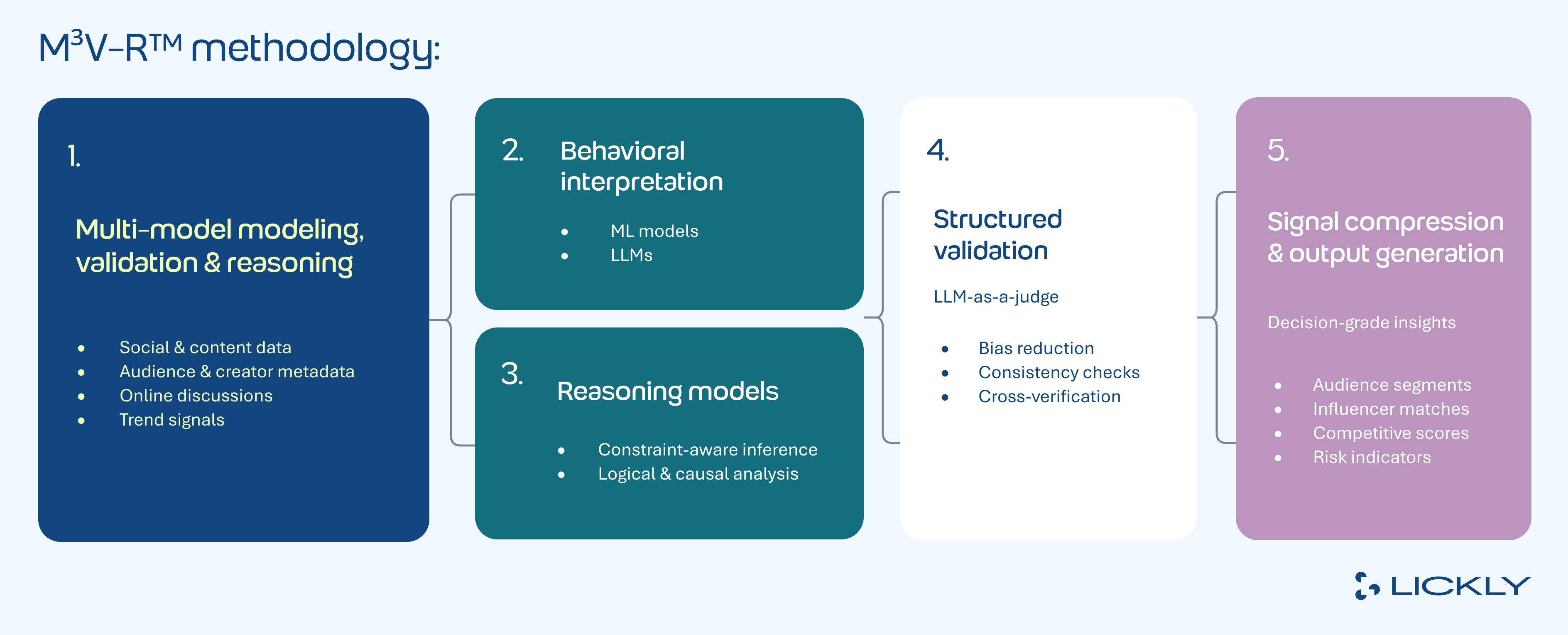
At Lickly's core is a proprietary methodology called M³VR(TM), or Multi-Model, Multi-Vector Reasoning. Most AI tools run one model down one reasoning path. Marketing decisions are messier than that, so M³VR runs multiple models, audience vectors, and reasoning paths at once, then checks the results against marketing signals before anything reaches you. Here's how, stage by stage.
Reasoning
A general-purpose LLM gives you the single most plausible answer in one pass. M³VR breaks the decision into the questions a strategist would ask. Who's the target audience? Which micro-communities move them? What conversations are shaping intent right now? Which creators align best? What themes are resonating? It reasons through each vector separately and in parallel, comparing paths instead of committing to the first answer that sounds right.
Judgment
Reasoning tells you what's true. Judgment tells you what to do. M³VR weighs the options against your objective, constraints, budget, and performance history, then ranks them by probability of hitting the outcome you set. The output isn't "here are ten influencers." It's "this combination is most likely to hit your objective, and here's why." One's a list. The other's a decision you can defend.
Grounding
Remember that 58-to-88% failure mode, the confident answer to a question the model can't verify? Grounding is the fix. M³VR draws its recommendations from Lickly's proprietary audience and influencer data, not a model's training memory. It reasons over verified signals instead of recalling half-remembered facts. That's the difference between a plausible-sounding follower count and the real one. The hallucination isn't caught after the fact; there's nowhere for it to start.
Cross-model validation
Grounding covers where the answer comes from. Cross-model validation covers whether it holds up. Multiple models evaluate the same question, and anything they can't corroborate against each other and against real audience data gets filtered out before you see it. A single model's confident error, the exact thing that Stanford study caught so often, doesn't survive the layer. One model's certainty isn't enough; the answer has to hold against the others and the data.
Bias correction
Single-model systems have a subtler flaw. They inherit their training data's blind spots, over-indexing on the biggest, most-covered creators and under-weighting emerging voices and niche communities. M³VR corrects for this: models with different training foundations check each other's skew, recommendations track observed audience behavior rather than raw popularity, and creators are scored on fit with your target, not general reach. The result is the high-alignment creator a general-purpose model would never surface, the under-the-radar partner who fits precisely because they aren't already famous.
Closing the workflow gap, not just the research gap
Go back to that six-stage chain and the walls between the tools that own each stage. The real problem was never any single stage. It was the handoffs, the seams where context drops and errors get laundered.
Getting the research decision right matters, and M³VR is built to. But the bigger benefit is to stop treating research as an isolated output you toss to the next disconnected tool, and instead reason about and ground the whole decision in one place. That's the shift from bolting a chatbot onto your workflow to running influencer decisions on a system built for them.
The real question isn't "can AI help?", it's "which AI was built for this?"
Ask ChatGPT "who are the best influencers for running shoes?" and you'll get a reasonable list. Ask Lickly and it starts somewhere else: Who's your audience? Which micro-communities move them? What's shaping intent right now? Which creators actually align? Which combination is most likely to hit your objective?
That's the gap between search and decision intelligence. Using a general-purpose chatbot to plan a campaign is like asking a sharp research assistant for advice. Using Lickly is like working with a strategist who already knows your audience, weighs the options at once, checks their own work, and points you to the highest-probability path.
LLMs are good at answering questions. Lickly answers a different one: what should I do next?
See M³VR run on your next campaign. Bring a real objective and watch it become a decision you can defend. Book a demo.