What Is an Influencer Marketing Platform? Looking Beyond the Feature List


Shopping for an influencer marketing platform should be simple. Instead, every demo starts to sound strangely familiar.
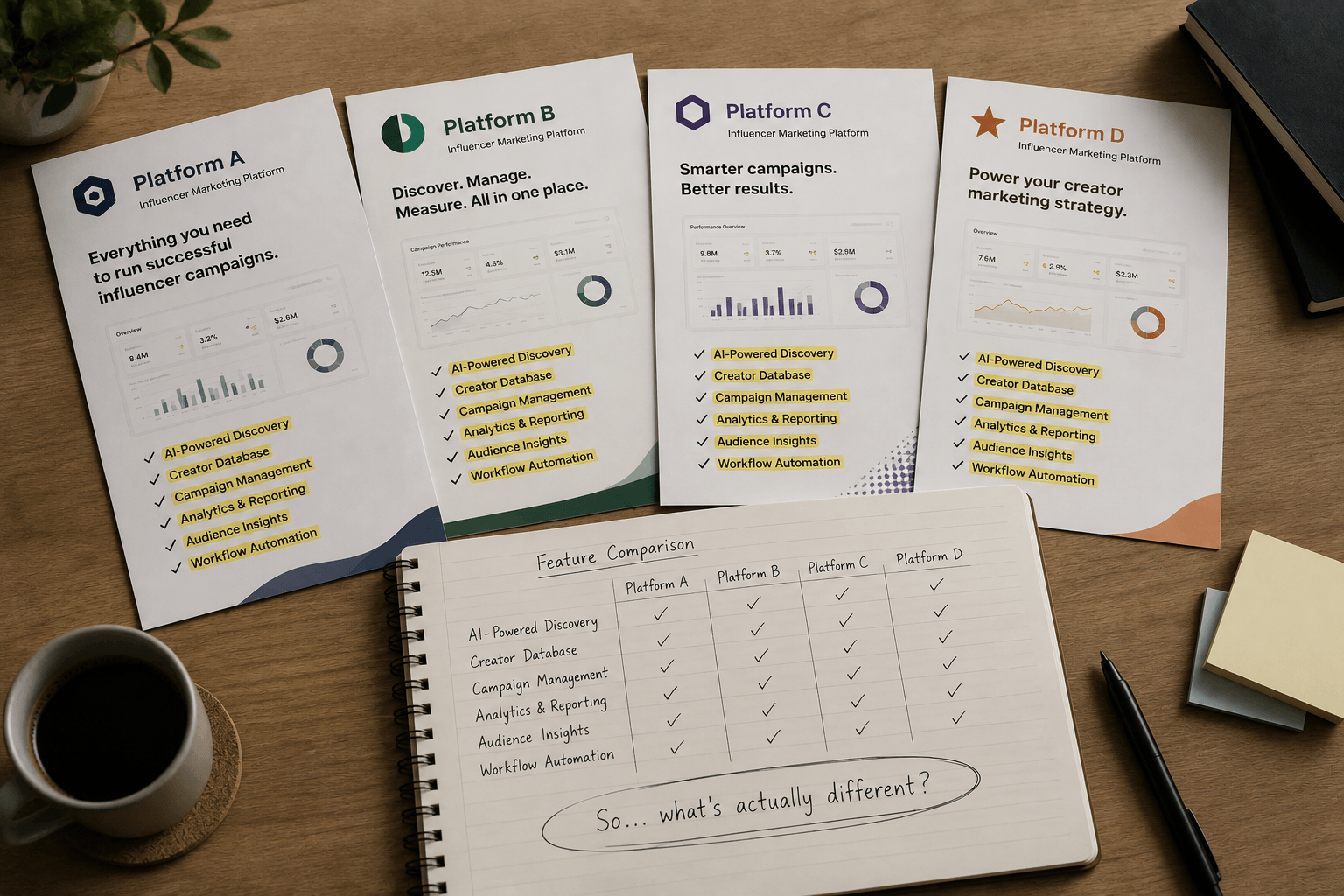
One platform promises creator discovery. Another emphasizes campaign management. A third highlights AI-powered analytics. A fourth says audience intelligence is the missing piece. By the end of the buying process, nearly every vendor claims to help brands find creators, run campaigns, measure performance and improve ROI.
All of them are technically right, and that's exactly why comparing them has become so difficult.
The term "influencer marketing platform" has expanded to describe products with remarkably similar feature lists, even when they were built around very different ideas about how creator marketing should work.
The biggest mistake buyers make isn’t choosing the wrong platform. It’s comparing platforms by their feature lists instead of the marketing decisions they improve.
So before comparing platforms, it’s worth asking the question:
What is an influencer marketing platform?
At its simplest, an influencer marketing platform helps brands plan, execute and measure creator marketing campaigns — discovering creators, managing outreach, approving content, tracking performance, processing payments and reporting results. Increasingly, it also means AI-powered audience analysis, creator recommendations and campaign planning built in from the start.
As a definition, that works. As a buying framework, it falls short. Ask what an influencer marketing platform does today, and the honest answer is: some combination of all of the above, depending on which vendor you ask. Nearly every modern platform now offers a version of each capability, which means knowing what features a platform includes tells a buyer very little about how it approaches creator marketing, or which decisions it's actually designed to improve. That's why so many demos start to blur together.
Why the category became so confusing
The earliest influencer marketing platforms solved one problem — helping marketers find creators. As the industry matured, brands expected more. Campaigns got larger, stakeholders multiplied, budgets grew, and teams needed better workflows, reporting, compliance and measurement to keep up.
Platforms evolved to meet those expectations. Discovery platforms added campaign management. Campaign management platforms added reporting. Reporting platforms added AI. Audience intelligence became part of campaign planning itself. Today, many of the strongest influencer marketing platforms offer some version of all four.
That's a good thing — software should evolve alongside the marketers using it. The challenge is that feature lists have become a poor way to compare products. When every platform eventually offers creator search, AI, reporting and workflow tools, buyers need another way to understand what actually separates one from another.
Every campaign starts with the same decisions
Behind every campaign sits a handful of recurring decisions. Who to work with, how to manage the campaign, how to know whether it worked, and who you're actually trying to influence in the first place. Every influencer marketing platform helps marketers answer those questions in some way. The difference isn't whether those capabilities exist — it's where the platform starts, and how those decisions connect to one another.
Finding the right creators
Most platforms begin by helping marketers identify potential creators. Search filters — audience size, engagement rate, content category, geography — make it easier to build a shortlist than ever before. Discovery remains one of the most important capabilities in creator marketing. The real question is what happens after that shortlist exists.
Running the campaign
Once creators are selected, campaigns need structure. Contracts, approvals, communication, payments, reporting and collaboration all become more important as programs grow, and strong operational tools reduce that complexity so campaigns can scale.
Measurement
After campaigns launch, marketers need to understand performance. Reporting dashboards help teams evaluate engagement, reach, conversions and ROI, giving leadership visibility into what happened and closing the loop for future planning.
Audience intelligence
The newest generation of platforms adds another layer entirely: decision intelligence. Instead of treating audience understanding as something marketers infer after finding creators, these platforms build it into the planning process itself — explaining why certain creators resonate with particular communities before a dollar is committed. Audience intelligence doesn't replace discovery, operations or measurement. It strengthens the decisions behind all three.
Every modern platform now includes some combination of these capabilities. What separates them isn’t whether they exist, but where the platform starts, because that starting point shapes every decision that follows.
Beyond the feature checklist
Modern influencer marketing platforms increasingly look alike on paper. Most have creator databases. Most use AI somewhere in the workflow. Most include campaign management and reporting. That overlap is exactly why feature checklists have become less useful than they used to be.
Features matter, but understanding which marketing decisions they improve matters more.
Some platforms put most of their value in operational efficiency. Others focus on reporting. Others start by helping marketers understand the audience before every other decision follows — and that starting point shapes how a campaign gets planned long before the first creator is ever contacted.
What really sets platforms apart
The phrase “influencer marketing platform” will probably continue to describe a wide range of products. That’s unlikely to change.
What is changing is the role those platforms play. As AI and predictive analytics become more deeply embedded, the next generation of platforms won’t simply automate campaigns, they’ll help marketers make better decisions before campaigns begin. That the shift toward decision intelligence.
Great creator marketing doesn’t begin with creator discovery. It begins with understanding the audience you’re trying to reach. That’s the principle behind Lickly’s audience-first approach.
Book a demo to see how it works.