Why Most Comic-Con Marketing Looks the Same

Every year, hundreds of brands descend on San Diego Comic-Con hoping to capture the energy of one of the world’s biggest cultural events. Social campaigns launch, creators get briefed, limited-edition products drop, and timelines fill with much of the same visual language: bold pop-art panels, halftone dots, comic-book lettering and copy calling on "fans" to assemble.
The irony is that Comic-Con is one of the most creatively diverse cultural events in the world. Comic-Con marketing often isn't. By the time the creative work begins, many campaigns are already heading in the same direction because they're built around the same audience assumption.
It's an easy trap to fall into. Briefs get written under deadline, agencies default to shorthand that's worked before, and "Comic-Con fans" feels specific enough to move a project forward.
But once that audience definition lands in the brief, every decision downstream inherits that assumption. Creative, creators, messaging — even the activation itself — start from the same oversized assumption.
One brand, two briefs
The easiest way to see the problem is to imagine the exact same brand writing two different briefs. Imagine a single brand, say, a beverage company, planning its Comic Con marketing campaign. If the brief says "Comic-Con fans," there's only one campaign to make: a booth, some pop-art signage, a handful of broadly-tagged "Comic-Con creators" posting from the show floor.
Now split that brief in two, aimed at two of the distinct communities Lickly identified inside San Diego Comic-Con 2026: Cosplay Vanguard and Gamerverse Enthusiasts.
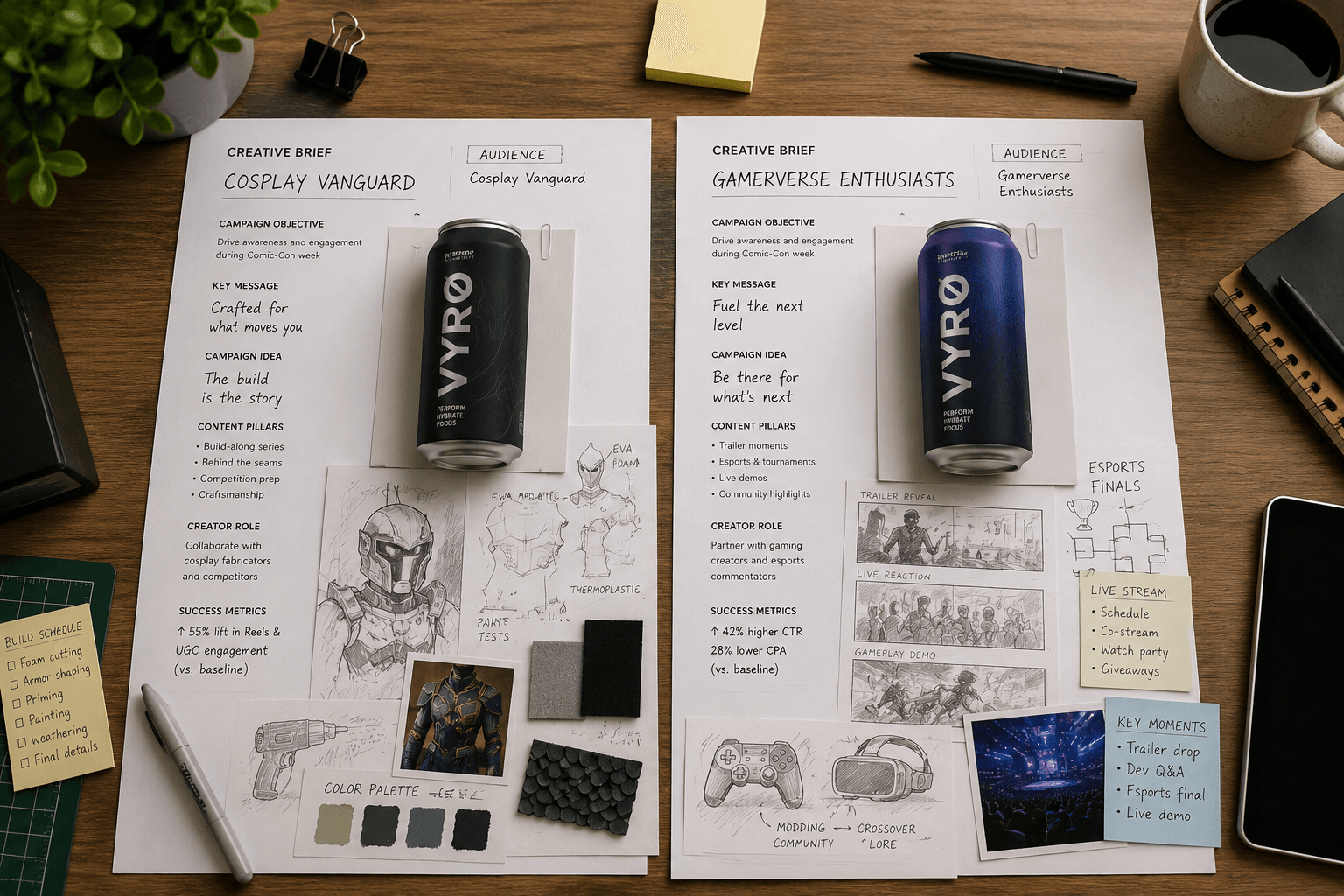
Cosplay Vanguard isn't simply "people who like costumes." Members spend months before the show sourcing EVA foam and thermoplastics, testing paint and finishing techniques, documenting build progress for followers who are tracking it in real time and prepping for competition long before they set foot on the show floor. For this audience, the convention is the finish line, not the starting point.
A campaign built for them looks nothing like a booth activation. The story is craftsmanship: a build-along series with a cosplay fabricator, a "behind the seams" look at how a competition costume comes together, product seeded into the process instead of the reveal. Lickly's predictive benchmarks project a 55% lift in Reels and UGC engagement against baseline for this audience.
Gamerverse Enthusiasts are somewhere else entirely. They're following trailer premieres, esports tournaments, VR demonstrations, modding communities, and crossover lore. Comic-Con simply brings all of those conversations into one place.
The same brand tells a completely different story. Instead of documenting the convention, it becomes part of a moment the audience already planned to watch — a trailer reveal, an esports final, or a live demo. The creator is covering something their audience already cares about, giving the product a natural place in the story. Same benchmarks project a 42% higher click-through rate and 28% lower cost per acquisition against baseline for this segment.
Same brand. Same week. Same budget tier. Two completely different campaigns — because the audience, not the event, is what actually shapes the brief.
From audience to creator
Most campaigns skip the hardest part. By the time a marketing team begins discussing creators, they've usually already made the most important decision without realizing it: they've defined the audience.
If that audience is "Comic-Con fans," every decision that follows starts from the same broad assumption. Creative concepts converge. Creator searches revolve around generic fandom categories. Media plans are built around an audience that was never clearly defined in the first place.
The mistake happens much earlier. It starts with creator discovery before the audience is clearly defined.
That’s why audience understanding has to come first. Once marketers identify the distinct communities inside a cultural moment, creator selection becomes far more intentional.
The audience brief determines the creator, not the other way around. Once the audience is specific, creator selection becomes much simpler. Instead of searching for "Comic-Con creators," brands can identify the people who have already earned trust inside the community they're trying to reach.
That's the idea behind audience first, creator second. Get the audience right, and everything downstream—creative, creator selection, media planning, and performance—becomes more intentional.
The next brief starts here
Comic-Con makes the pattern easy to see because so many brands are chasing the same cultural moment at once. The same flattening happens at product launches, tournaments, award shows, and anywhere else a marketing team mistakes a crowd for an audience.
The beverage brand from earlier didn't need two campaigns because Comic-Con was unusual. It needed two because Cosplay Vanguard and Gamerverse Enthusiasts experienced the same event in completely different ways.
That's true of almost every audience a brand tries to reach. The size of the audience is easy to measure. The reasons people showed up rarely are.
Great creator marketing doesn’t begin with creator discovery. It begins with understanding the audience you’re trying to reach.
That’s the principle behind Lickly’s audience-first approach.
Book a demo to see how it works.