Influencer Marketing vs. Paid Social: Why Influencer Marketing Delivers 3x Higher ROI


Every CMO I talk to is having some version of the same conversation with their finance team. Paid social costs keep climbing, performance keeps flattening, and the board keeps asking why customer acquisition costs went up again this quarter. Meanwhile, the channel that consistently benchmarks at $5 or more in return for every dollar spent still gets treated like a side project in most media plans.
At Lickly, we see this same trend reflected in creator planning. Brands that begin with audience intelligence before selecting creators consistently make better investment decisions and improve campaign performance over time
That gap between where the returns are and where the budget sits is the subject of this piece. The data on influencer marketing ROI is now mature enough, and consistent enough across sources, that the old "influencers are a nice-to-have" position no longer survives contact with a spreadsheet.
Why paid social ROI is declining?
Paid social still works. Let's get that out of the way. It's targetable, scalable, and instantly measurable, which is exactly why every brand in your category is bidding on the same audiences you are. That crowding is the problem. Auction-based pricing means CPMs rise as demand rises, and demand has done nothing but rise for a decade. Privacy changes on iOS and the slow death of third-party cookies made targeting blunter at the same time, so brands now pay more for impressions that convert less precisely.
The practical result is a plateau. As Socially Powerful notes in its 2026 comparison of influencer marketing and paid media, paid channels deliver quick bursts of visibility, but the content is perceived as direct advertising and carries lower trust, which caps how hard each impression can work. Many performance teams quietly treat a roughly 2:1 blended return as an acceptable outcome for a mature paid social account. Read that again. The default channel in most North American media plans is considered healthy when it merely doubles its money, before creative, agency, and team costs.
Hold that 2:1 figure in your head. It's the baseline the rest of this article measures against.
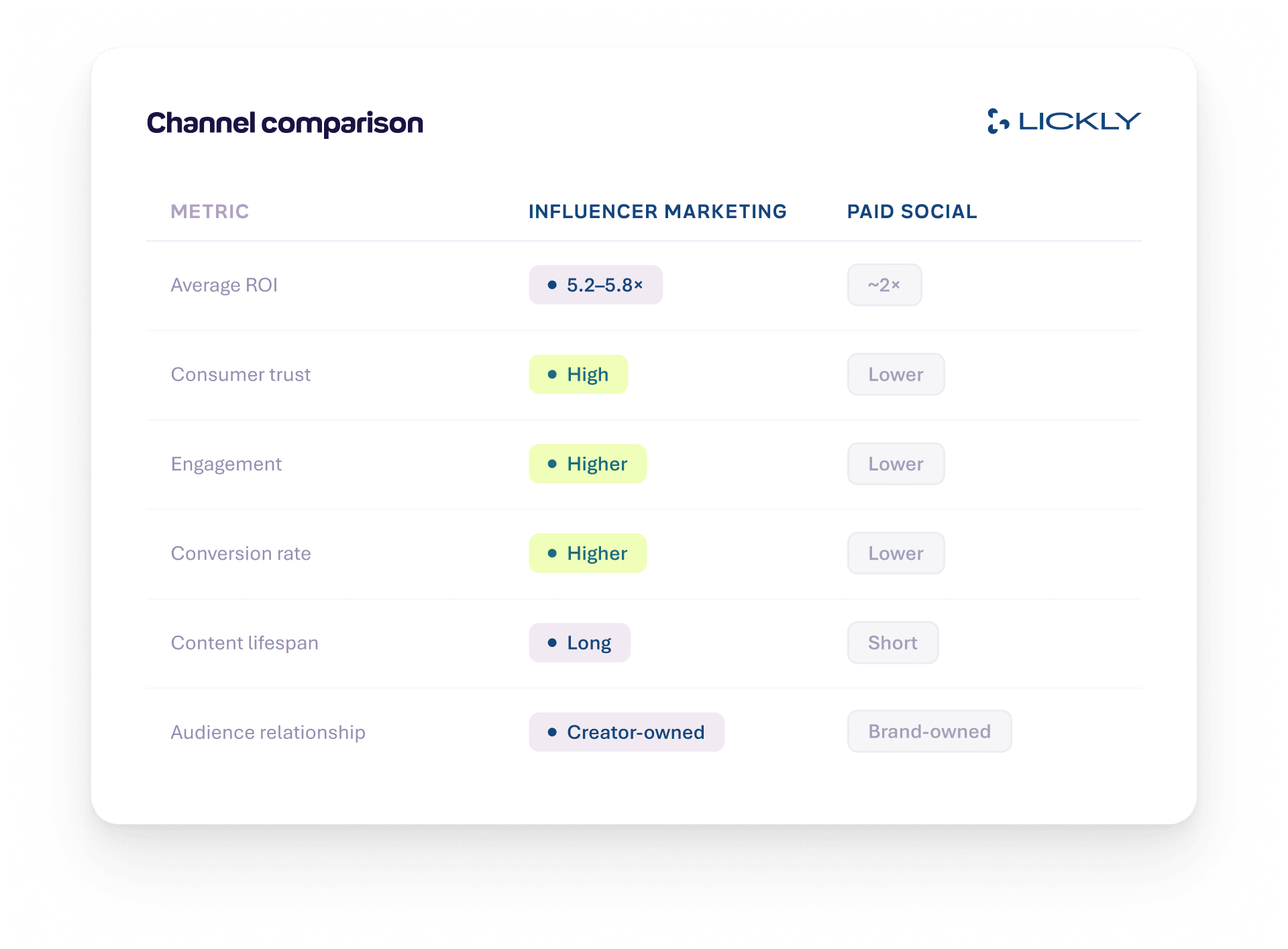
The new ROI benchmark: influencer marketing's 5.78:1 payoff
The most widely cited figure in the industry comes from Influencer Marketing Hub's benchmark research, which puts the average return at $5.20 for every $1 invested in influencer marketing. The Digital Marketing Institute's figure runs slightly higher at $5.78 per dollar. Moburst's March 2026 analysis of the available data lands on that same $5.20 to $5.78 range as the working benchmark across industries, platforms, and creator tiers.
Compare that to the 2:1 return that passes for success in paid social and you get the headline math: influencer marketing is returning roughly three times as much per dollar. ZipDo's 2026 education report, which aggregates data from sources including Statista, eMarketer, and HubSpot, goes further, finding that influencer investment yields around 4x the ROI of paid ads and that 70% of marketers say the channel outperforms traditional advertising on return.
Reasonable people can debate any single figure. What's harder to debate is the pattern. Multiple independent sources, using different methodologies, keep landing in the same place: this is the channel where a marketing dollar currently works hardest. That makes 5:1 the new reference point for what "good" looks like when comparing influencer vs paid social, and it should reset how you evaluate every line in your media plan.
Average vs elite ROI: why 5x Is the floor, not the ceiling
Averages hide the upside. According to Moburst's 2026 data review, top-performing campaigns regularly return between $11 and $18 per dollar, and Archive's compilation of influencer marketing statistics cites SociallyIn data showing elite campaigns reaching $18 to $20.
The tier structure matters here. Moburst's benchmarks put well-executed micro-influencer campaigns at 5x to 8x ROI, with macro campaigns typically landing between 3x and 5x. One instructive case from Stack Influence: a DTC cleaning brand activated 211 micro-influencers on Instagram and generated a 13:1 return alongside a 4.7x lift in monthly Amazon sales.
Two hundred and eleven creators is not an experiment. It's a media program with defined inputs, repeatable processes, and measurable outputs, run at a scale that would be familiar to any performance marketer. That's the mental shift the influencer marketing benchmarks demand: this channel scales like performance media, not like a one-off brand stunt.
Why some influencer campaigns deliver better ROI than others
Not every influencer campaign produces exceptional returns.The biggest difference starts with understanding the audience before choosing creators.Brands that first identify the communities, interests and purchase intent they want to reach are far more likely to choose creators whose audiences convert. Campaigns built around audience intelligence consistently outperform campaigns built around follower count alone.
That's one reason influencer marketing ROI varies so widely across brands.
Why influencer marketing generates higher ROI
What consistently separates influencer marketing is borrowed trust. Brands gain access to credibility that already exists between creators and their audiences.
Archive's 2026 research roundup finds that 69% of consumers trust influencer recommendations over direct brand messaging. Sprout Social's 2025 Influencer Marketing Report shows this trust translating into behavior, with 86% of consumers making at least one influencer-inspired purchase per year and 49% buying on creator recommendations daily, weekly, or monthly. ZipDo's compiled data adds a telling detail: 85% of users say influencer content feels like a recommendation from a friend.
A friend's recommendation and an interruption from a brand are processed completely differently. One triggers skepticism and the mental ad-blocker we've all developed. The other triggers consideration. That difference in reception is the entire economic engine behind creator marketing ROI.
From impressions to recommendations: what a "trusted impression" is worth
Think of it as two different products that happen to share a unit of measurement.
A paid impression buys a fraction of a second of contested attention. An influencer impression buys a recommendation delivered inside an existing relationship.
The performance data reflects this. In Sprout Social's research, 69% of marketers say influencer-generated content outperforms their brand-directed content, with 92% reporting better reach, 90% better engagement, and 83% higher conversions from creator content on average. On engagement specifically, micro-influencers deliver rates of roughly 3% to 6% per Moburst's benchmarks, against the 1% to 2% typical of large accounts and most branded content.
This is why a nominally higher cost per creator impression can still be the cheaper buy. If a trusted impression engages at 3x the rate and converts meaningfully better, its effective cost per outcome undercuts the "efficient" paid impression by a wide margin. CPM comparisons between the two channels are, frankly, comparing the wrong things.
86% of US marketers use influencers
If you're worried influencer marketing is still experimental, the adoption data should settle it. Statista figures cited in Sprout Social's 2026 statistics roundup show that 86% of US marketers partnered with influencers in 2025. The same roundup notes that 26% of agencies and brands worldwide now allocate more than 40% of their marketing budgets to influencer partnerships.
Budgets are following conviction, not curiosity. Later's State of Influencer Marketing research, cited by Archive, found that 80% of brands maintained or increased their influencer budgets in 2025, with 47% raising them by 11% or more. When four out of five brands hold or grow a line item during a period of general budget scrutiny, that line item has proven itself internally.
Why CMOs, founders, and agencies are shifting budget
The decision logic behind these shifts is unglamorous and financial. Paid social costs keep rising while its marginal returns flatten. At the same time, influencer measurement has matured dramatically: Archive's data shows 74% of brands now track sales directly from influencer campaigns through affiliate links, promo codes and UTM-level attribution. The old objection that "you can't measure it" belonged to 2019.
Quality is part of the calculus too. In Moburst's summary of Sprout Social's survey of 650 marketers, 82% said influencer-sourced leads are higher quality than leads from other channels, and only 5% reported a negative experience with influencer campaigns. Customers who arrive pre-sold by someone they trust behave differently: they convert faster, return less and stick around longer. For a founder watching LTV-to-CAC ratios, that compounds.
The media mix myth: why paid social isn't the "safe" bet anymore
Here's where I'll push against the industry's default framing. In most planning meetings, paid social is treated as the safe allocation and influencer spend as the risky test. That framing is backwards, and it's costing brands real money.
Run the risk-adjusted logic. One channel has a documented average return of $5.20 to $5.78 per dollar, adoption by 86% of US marketers, and maturing attribution infrastructure. The other is a saturated auction where healthy performance means roughly 2:1, where your costs are set by competitors' bids, and where a single platform policy change (an algorithm update, a privacy shift, a CPM spike in Q4) can reprice your entire acquisition model overnight. Which one is actually risky?
Yes, individual influencer campaigns have variance. Some creators underperform. But paid social's "predictability" is largely predictable mediocrity, plus concentrated platform risk that most media plans never price in. A channel where the average outcome nearly triples the incumbent's ceiling, and where Amra & Elma research cited by Archive suggests the gap versus traditional digital advertising can run as high as 11x, offers enough margin of safety to absorb plenty of campaign-level misses and still come out ahead.
For growth-focused brands in 2026, the bigger financial risk may be staying paid-only while competitors build creator programs that become cheaper and more effective with each cycle.
The real risk: not building a creator portfolio
The variance objection also has a structural answer: diversification. A creator portfolio, meaning a managed mix of micro and macro influencers across niches, platforms and content formats, behaves like any diversified asset base. No single underperformer sinks the quarter, and winners can be identified and scaled.
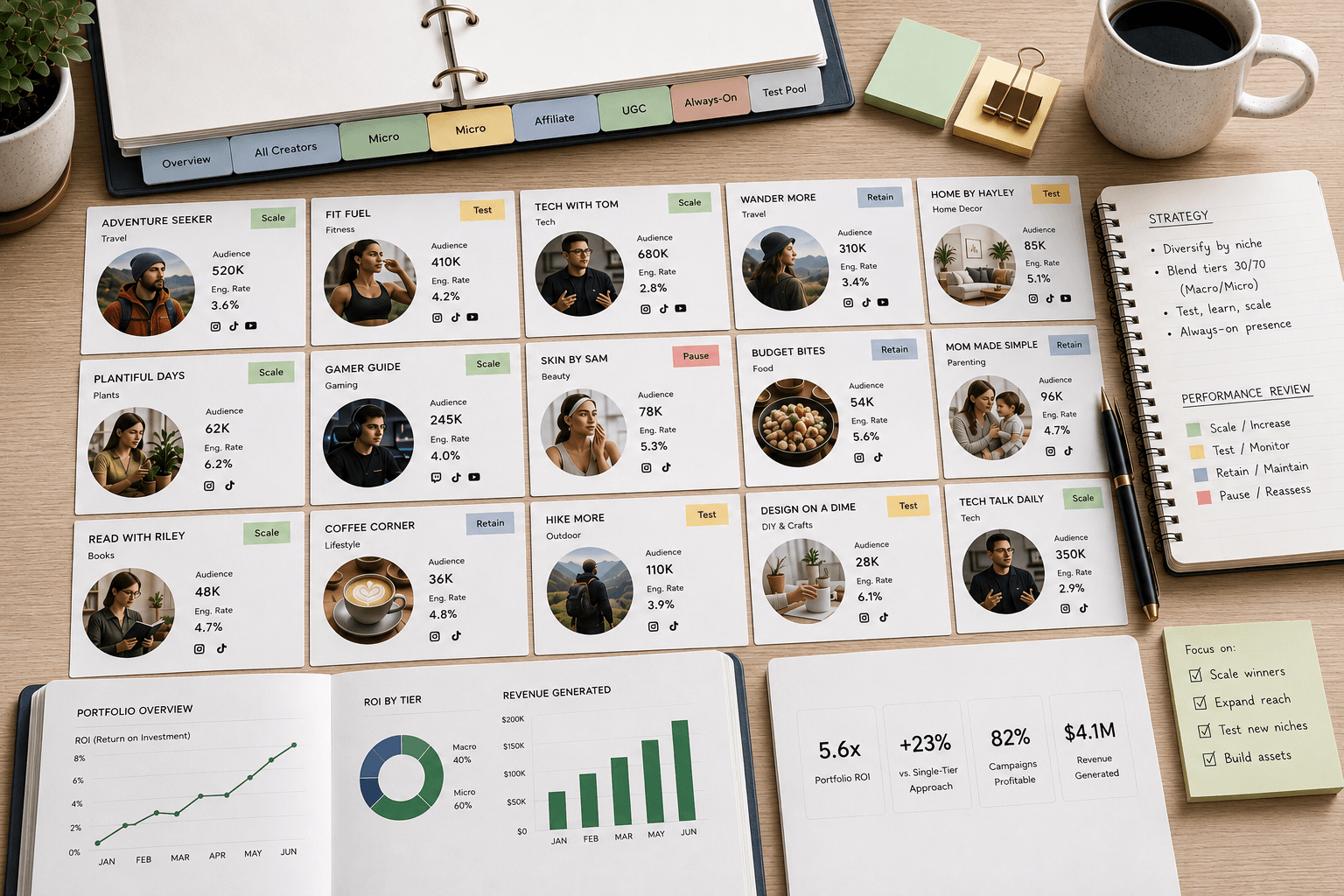
The data supports blending tiers deliberately. Moburst cites benchmarks showing that a roughly 30/70 macro-to-micro allocation delivers about 23% better overall ROI than single-tier approaches. Contrast that with the typical paid-only brand, which has concentrated its entire acquisition engine on one or two ad platforms it doesn't control. From a portfolio theory standpoint, that's the undiversified position, not the influencer program.
Where influencer ROI comes from: micro, macro, and always-On programs
Understanding the return means understanding its components. The strongest programs combine three structural drivers: a long tail of micro-creators for efficient conversion, macro partnerships for reach and always-on relationships that compound over time rather than resetting with every campaign.
Micro-influencers: your high-ROAS long tail
Micro-influencers are best understood as long-tail performance media. Per Moburst's 2026 benchmarks, they cost between $100 and $1,000 per Instagram post, engage audiences at 3% to 6%, and cost about $0.20 per engagement versus $0.33 for macro creators, roughly 65% less per meaningful interaction. Executed well, these campaigns commonly return 5x to 8x.
The industry has noticed. Later's research cited by Archive found that 73% of brands now prefer working with micro and mid-tier creators. Their niche relevance is the point: a creator with 40,000 followers who all care about trail running will outsell a generic celebrity for a trail shoe brand every time.
Macro influencers and creators: your reach and launch vehicle
Macro creators play a different position. At 3x to 5x typical returns, they're less efficient per dollar, but they deliver something micros can't: concentrated mass visibility on demand. For product launches, category entries and cultural moments, a macro partnership generates awareness and brand salience at a speed and credibility level that paid reach campaigns struggle to match, because the message arrives with a face and a following attached. The most effective programs combine macro creators for ignition with micro creators for sustained conversion.
How to rebalance your media mix toward influencers
None of this argues for abandoning paid social. It argues for repricing it in your plan and reallocating accordingly. For most brands, shifting 10% to 30% of social budget into a structured creator program is an appropriately sized first move: large enough to produce statistically meaningful results, small enough that no CFO loses sleep. Refersion's work on combining influencer and paid media makes the case that the two channels are strongest together, so treat this as rebalancing, not replacement. Three steps make it disciplined.
Step 1: Define your ROI thresholds and benchmarks
Before moving a dollar, set the bar. Given documented averages of $5.20 to $5.78 per dollar, a sensible framework is a 3:1 minimum threshold for continued investment and a 5:1 target at maturity. Then, and this is the part most teams skip, hold every channel to the same standard. If your influencer program must clear 3:1 to keep its budget, your paid social program should face the same test. Many won't pass it.
Step 2: Build a creator portfolio, not one-off collabs
One-off collaborations are the most expensive way to buy influencer marketing. Sprout Social's 2025 report found that 71% of influencers offer discounts for longer-term partnerships, and that sustained relationships produce more credible, higher-performing content because audiences watch the affinity develop over time. Structure your portfolio deliberately: define tiers (nano, micro, macro), map creators to audience niches and run quarterly test-and-learn cycles that graduate proven performers into ongoing contracts.
Step 3: Integrate influencer content into performance media
This is where the returns compound. Creator content shouldn't live and die in a creator's feed. Whitelisting, boosting and repurposing that content as your paid ad creative merges influencer authenticity with paid targeting precision, and it's already standard practice: Aspire's State of Influencer Marketing 2026 data, cited by Sprout Social, shows 77% of marketers actively repurpose creator content in paid ads. Moburst's benchmarks indicate creator content run as paid typically delivers 2x to 3x higher engagement at a lower cost per acquisition than brand-produced creative. Your influencer program, in other words, also fixes your paid social program.
Proving ROI to your CFO: dashboards, attribution and case narratives
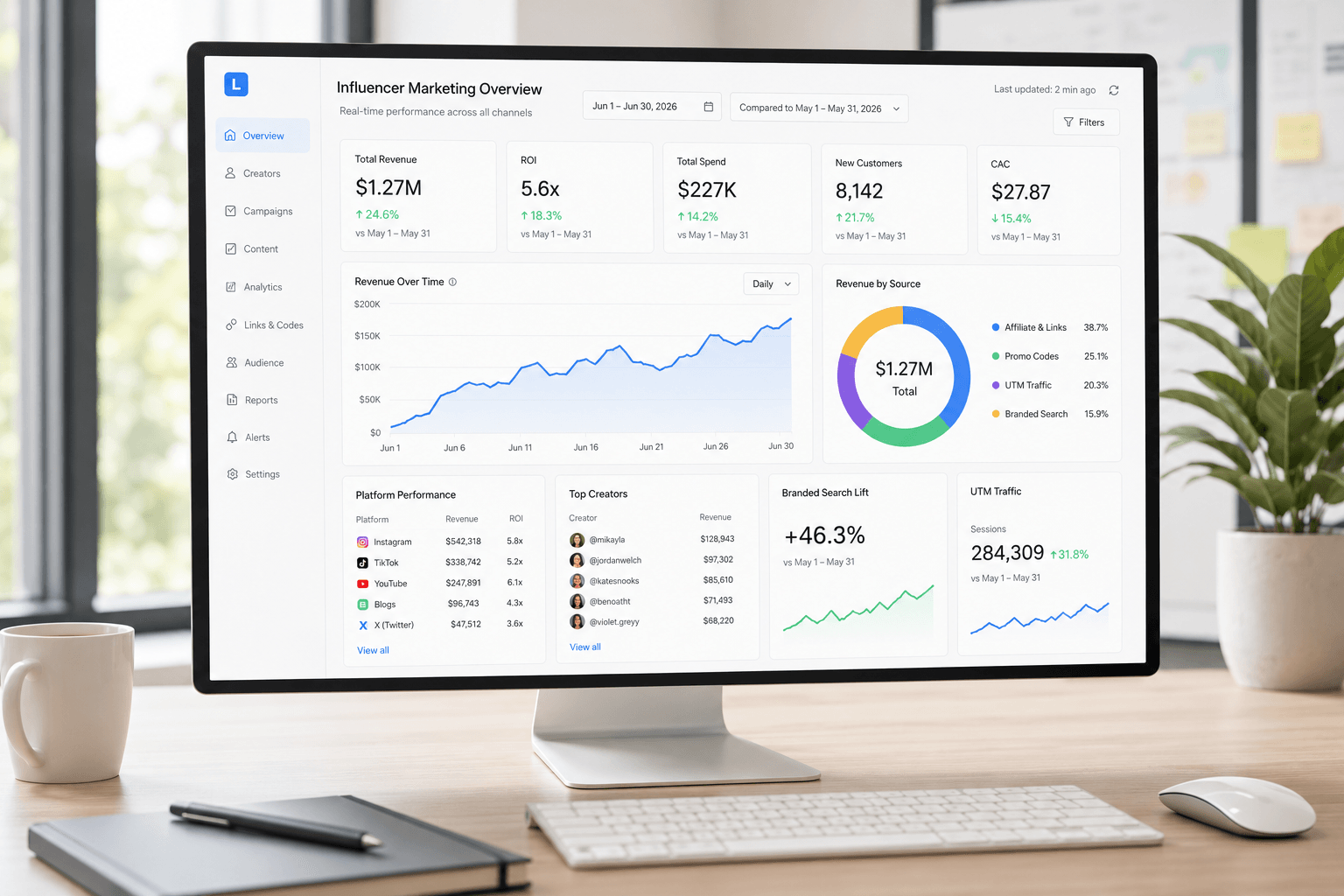
Winning the budget requires speaking finance. Three tools do the job. First, a unified dashboard that consolidates platform analytics, affiliate and promo code sales, UTM traffic and branded search lift into a single view, refreshed continuously rather than assembled manually after each campaign. Second, an honest attribution model: track direct response rigorously and use earned media value and incrementality tests to capture the awareness effects that convert downstream. Third, case narratives. A one-page story showing that a specific $50,000 creator flight produced $290,000 in attributed revenue lands harder in a board deck than any engagement chart.
From campaigns to balance sheet: framing influencer spend as a growth asset
The most persuasive reframe is temporal. Paid social spend is fully consumed the moment the impression is served. Influencer spend builds assets that persist: a library of authentic content you can redeploy across channels for months, creator relationships that get cheaper and more productive over time and accumulated audience trust that lifts brand equity and margin. Archive's data point that 82% of marketers consider influencer-acquired customers higher quality speaks to the same idea. This is investment with residual value, not pure expense, and finance leaders understand that distinction instinctively.
Closing argument: if you're not getting 5x ROI, your media mix is mispriced
The financial case reduces to a few numbers. Influencer marketing averages $5.20 to $5.78 in return per dollar. Elite campaigns reach $11 to $20. Micro programs repeatedly deliver 5x to 8x. Paid social, the channel that still commands the majority of most social budgets, is considered healthy near 2:1. When influencer marketing vs traditional advertising comparisons keep producing multiples like these, across independent sources and methodologies, the burden of proof has flipped.
A modern, data-driven media mix that excludes a structured creator program is leaving documented returns on the table. So here's the assignment: pull your blended ROAS by channel for the last four quarters, set a 5:1 target and move your first 10% to 30% of social budget into a measured creator portfolio this quarter. Your CAC curve and your CFO will tell you soon enough whether the benchmarks hold. The data says they will.
Key takeaways:
Influencer marketing averages 5–6x ROI.
Paid social averages approximately 2x ROI.
Audience trust is the biggest driver of performance.
Creator content strengthens paid media.
Audience-first planning improves campaign ROI.
Brands should evaluate both channels using the same financial benchmarks.
If you're ready to move more budget into creators, the hard part isn't deciding. It's the operational lift of finding the right creators, managing dozens of relationships, and proving the return to your CFO. Lickly handles all three in one platform, turning the playbook above into a program you can run this quarter.
Book a demo to see how it works.