Why 'Find Influencers in Your Niche' Is Bad Advice

It's one of the most repeated pieces of marketing advice out there: find influencers in your niche.
You filter by category. Search by topic. Pick the best fit from the list. It's the default starting point for most influencer discovery — but it's built on a category error.
Niche is a content filter. It groups creators by subject matter, even when the audiences behind those creators have little in common.
A niche isn't an audience
When a brand searches for niche influencers, they get back a list of creators who post about a particular topic. What that search can't surface is who those creators' audiences are — their motivations, their purchase behaviors, their relationship with the content or whether they have anything in common with the people the brand is trying to reach.
Within any niche, the audience variation is enormous. Take personal finance. A creator in that space might have an audience of recent graduates managing student debt, mid-career professionals building investment portfolios or small business owners thinking about cash flow. The niche label covers all of them. A brand's actual target segment covers maybe one.
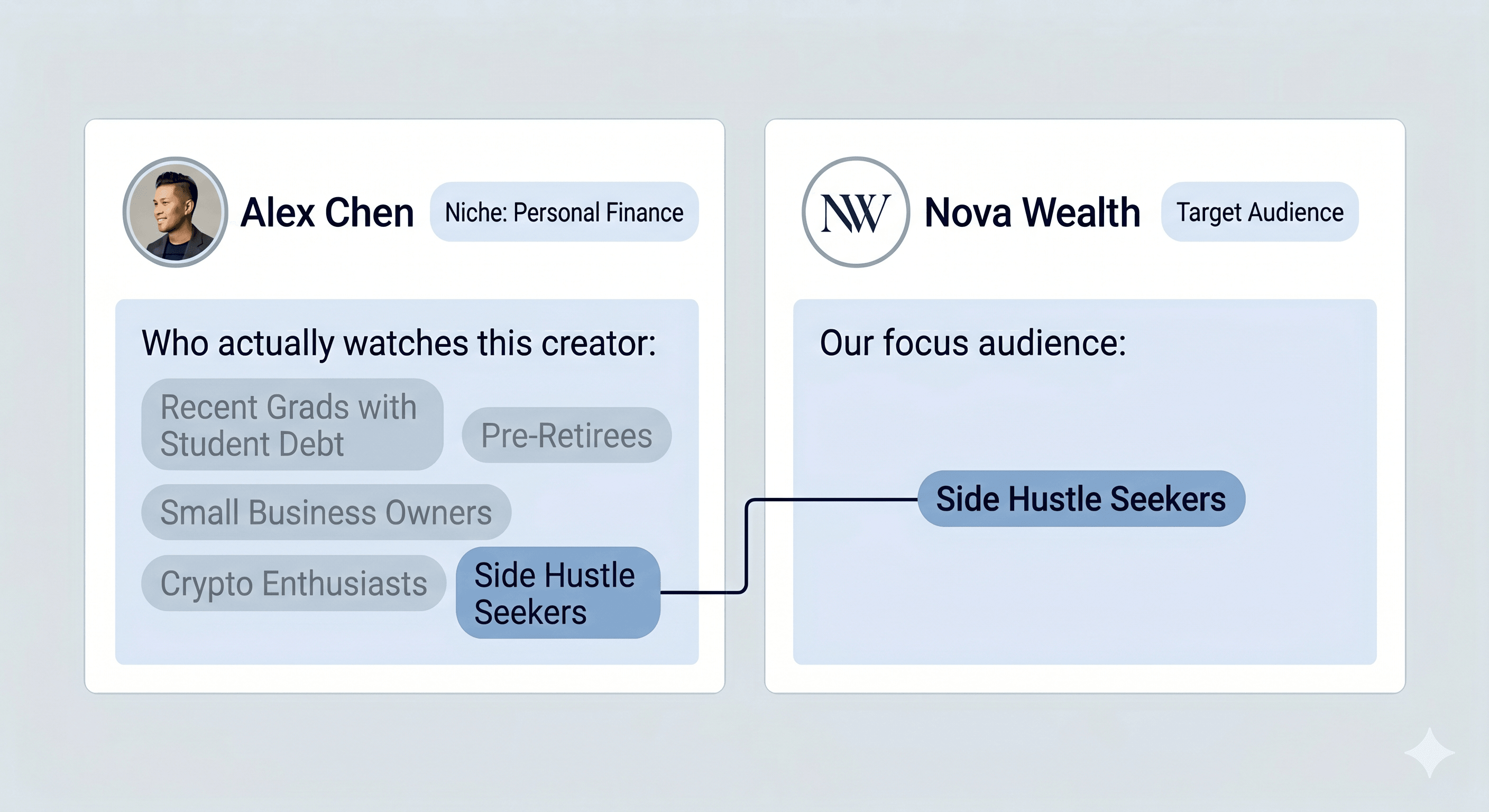
That variation is invisible at the niche level. Influencer targeting that starts with a content filter flattens it into a single label — and the shortlist that comes out of it is built on content similarity rather than audience overlap. The campaigns that follow are only as good as the assumption that niche equals fit. Which it frequently doesn't.
Why the category match feels convincing
Niche filtering persists because it's the path of least resistance. Most discovery tools are organized around content categories — it's how creators get tagged, how search results get surfaced and how shortlists get built. When the tool only offers one starting point, teams use it.
There's also comfort in the logic. A pet food brand searches for pet influencers. A travel brand searches for travel creators. The category match feels like it should be enough. And sometimes it is — when the brand happens to be targeting an audience broad enough that content category and audience fit roughly overlap.
But for most brands with a specific target segment, that overlap is more assumed than verified. That’s an expensive assumption to make. The niche filter gives teams something to work with quickly. Whether it's actually getting them closer to the right audience is a different question — one that usually doesn't get asked until the performance data comes back and the team is looking for somewhere to place the blame.
A better starting point
Niche still has a role in the process, it just shouldn't be the first filter. Here's how to reorder the decision.
1. Know who you're trying to reach
Before any creator search begins, the audience picture needs to be clear. Not a broad demographic profile, those rarely tell the whole story, but a behavioral and psychographic understanding of who the brand is actually trying to reach.
That means going beyond age range and income bracket. Which micro-communities does this audience participate in? What content are they already responding to, and what makes them stop scrolling? What motivates their purchase decisions in this category — is it status, performance, belonging, value? Which voices carry genuine trust inside the spaces they actually spend time in?
Answering those questions before a creator search begins changes everything that follows. The more clearly defined the audience, the more useful every subsequent filter becomes, including niche.
2. Understand the audience before evaluating creators
Most discovery tools start with creators and layer audience data on top. Lickly inverts that. Before a creator is ever considered, Lickly builds a detailed picture of the brand's target audience — surfacing the micro-communities that matter, the behavioral signals that define them and the content themes already resonating inside those spaces.
That means a brand team can walk into a creator search knowing exactly who they're looking for on behalf of. The influencer discovery process becomes a matching exercise against a defined audience profile rather than a category browse. Niche influencers who genuinely reach the right audience rise to the top. Those who just post about the right topics don't make the cut.
3. Let niche validate the decision
Once the audience picture is clear and a preliminary creator list is in place, niche becomes genuinely useful. At that stage, content category is a sense-check — does this creator's format, tone and topic mix fit naturally with what the brand is asking them to do? Is the integration going to feel authentic to their community or forced?
That's the right job for a niche filter. It validates creative fit after audience fit is already confirmed. In that sequence, it adds real value. As the starting point for influencer discovery, it's the reason most shortlists are built on the wrong foundation before the first brief is written.
The real problem with 'find influencers in your niche'
Every decision that follows a creator search — the brief, the creative direction, the performance expectations — is only as strong as the audience understanding behind it. When that's clear before the search begins, niche becomes a useful filter. When it isn't, niche becomes a substitute for thinking the audience question through.
Get the starting point right and the decisions downstream get easier. Creator selection becomes a matching exercise rather than a gut call. Briefs get written for real people rather than demographic profiles. Performance expectations are grounded in something more reliable than category overlap. The search is still part of the process — it just stops being where the process begins.
Most influencer platforms optimize creator discovery. Lickly optimizes audience alignment. That difference changes every downstream decision — from creator selection to performance outcomes.
Start a free trial or book a demo to see how it works.